Introduction: The Most Costly Mistake in Outreach is Not a Bad Email
You can have a perfectly written email, verified contacts, and excellent deliverability. If you send it to the wrong companies, none of that will help.
Most unsuccessful campaigns fail not because of the text. They fail because no one properly defined who they are actually writing to. "We are targeting companies" is not a target audience. "Small and medium enterprises" is not either.
ICP — Ideal Customer Profile — is an exact description of the company for which your service is most relevant. This article shows how to define it based on data, not impressions.
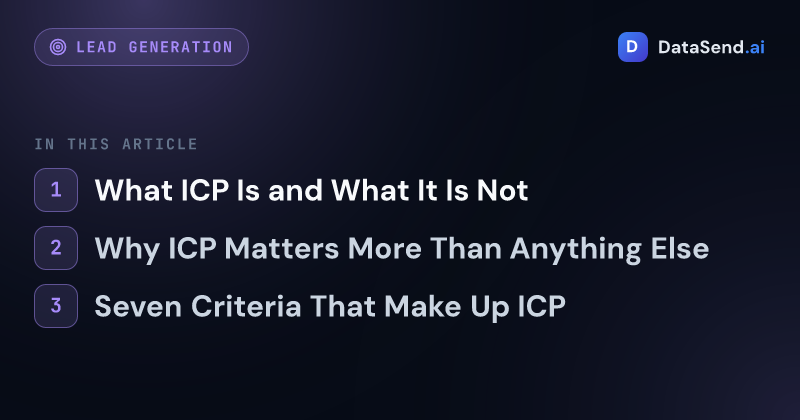
1. What ICP Is and What It Is Not
ICP is a description of a company. Industry, size, revenue, region, situation they are in.
Persona is a description of a person within the company. Position, responsibilities, problems they are solving.
You need both, but ICP comes first. First, you determine which companies to target, then whom within them.
ICP is not a wish list. It is not "companies with large budgets that make quick decisions and do not negotiate on price." It is a description of companies where your service actually solves a real problem.
ICP is not definitive. It changes as your offering and experiences change. The first version is an estimate that you will adjust based on data after a few months.
2. Why ICP Matters More Than Anything Else
It affects reply rate. A relevant offer for the right company has a significantly higher chance of getting a response than a great email sent to a company that does not need your service.
It affects pricing. If you are targeting micro-businesses, your price must be low. If you are targeting medium-sized companies, it can be significantly higher for the same work.
It affects efficiency. With a clear ICP, you will reach out to 300 relevant companies. Without it, you will reach out to 3,000 random ones and achieve worse results.
It affects deliverability. This is something few people realize. Emails that no one opens and no one responds to harm your domain's reputation. Inaccurate targeting is therefore also a technical problem.
3. Seven Criteria That Make Up ICP
Criterion 1: Industry. The more specific, the better. Not "retail," but "online furniture and home goods stores."
Criterion 2: Size. The number of employees is the most usable criterion. A company with three employees and a company with fifty have completely different budgets and decision-making processes.
Criterion 3: Revenue. This directly relates to how much a company can afford. If your service costs 800 euros per month, a company with an annual revenue of 50,000 euros is out of reach.
Criterion 4: Region. Crucial for local services. For remote services, it determines language and business culture.
Criterion 5: Legal form. A sole trader and a limited liability company are two different types of customers with different budgets.
Criterion 6: Digital maturity. Does the company have a website? Is it modern? Are they running ads? Do they have an online store? For digital services, this is often the best indicator of whether to approach the company at all — and with what offer.
Criterion 7: Situation or trigger. A company that has just expanded, hired new staff, or changed leadership is more open to new suppliers than a company in a stable state.
4. How to Define ICP When You Already Have Clients
If you have at least five clients, you have data — and that is better than any estimate.
Step 1: List all your current clients in a table. For each, include the industry, number of employees, estimated revenue, region, and how much they paid you.
Step 2: Mark the best ones. Not those who paid the most, but those who were overall the best — paid well, communicated well, stayed long, referred you further.
Step 3: Look for common traits. Are they from the same industry? Do they have similar sizes? Similar revenues? Similar situations?
Step 4: Also look at the worst ones. What did clients who negotiated every euro, delayed payments, or left quickly have in common? This is your anti-ICP and is equally useful.
Step 5: Write a profile. One sentence that summarizes it.
5. How to Define ICP When You Don't Have Clients Yet
Without data, you are working with a hypothesis — and that is okay as long as you validate it later.
Step 1: Who derives the most value from your service? Not who can use it, but who will gain the most from it.
Step 2: Who can afford it? Calculate what revenue a company needs to have for your price to make sense for them.
Step 3: Where do you have context? An industry you know from previous work is a significantly better start than an industry you know nothing about.
Step 4: Is the market big enough? This is the step that is most often skipped. If your criteria are met by 150 companies, you have nothing to build on.
At DataSend.ai, you can immediately verify the size of your target audience — set the industry, region, revenue, and number of employees, and see how many companies meet the criteria across seven countries. If the result is too small, broaden the criteria. If it is too large, narrow them down.
Step 5: Test it. Reach out to 50 companies from your hypothetical ICP and look at the reply rate. Then 50 from another segment. The difference will tell you more than a month of analysis.
6. ICP Template
Fill in your own values.
Industry: [for example, online furniture and home goods stores]
Number of employees: [for example, 5 to 50]
Annual revenue: [for example, over 500,000 euros]
Region: [for example, Czech Republic and Slovakia, or specific regions]
Legal form: [for example, Ltd. and joint-stock company]
Digital maturity: [for example, they have an online store but do not systematically invest in advertising]
Problem they solve: [for example, high cost per order from paid advertising]
Who decides: [for example, owner or marketing manager]
Why they are ideal: [for example, measurable results, repeat collaboration, budget for retainer]
Who does not belong to ICP: [for example, companies under 300,000 in revenue, exclusively brick-and-mortar stores without an online store]
7. Common Mistakes When Defining ICP
Too broad ICP. "Small and medium enterprises in Europe" is not ICP. It won't help you with targeting or writing emails.
Too narrow ICP. "Veterinary clinics in Trenčín region with five to seven employees" may mean twenty companies. That is not enough for a stable pipeline.
ICP based on wishes. Companies with huge budgets that do not negotiate do exist — but they are few and everyone targets them.
Ignoring budget. The most common mistake. If you are targeting a segment where the average company is a micro-business with revenue under 100,000 euros, your price must reflect that — regardless of how good your service is.
Define once and never update. After twenty clients, you will know more about your ICP than at the beginning. Use that.
8. How to Use ICP in Practice
When filtering a database. The criteria from ICP are direct filters. Industry, region, revenue, number of employees.
When writing an email. When you know exactly who you are writing to, you also know what problem to address. A generic email is usually a result of an unclear ICP.
In pricing. ICP will tell you what price you can afford to ask for.
When deciding on clients. A request from a company outside of ICP can be declined or priced higher — you know that collaboration will be more challenging.
When creating a case study. A case study from your ICP segment is significantly stronger than one from a random industry.
Conclusion: An Hour of Work That Will Change Everything Else
Defining ICP takes an hour. However, it will affect every email you send, every price you offer, and every decision about whom to approach.
It does not have to be perfect on the first try. It just needs to be specific — and you should adjust it after thirty approached companies based on what the data shows you.
The worst ICP is no ICP. That means you are reaching out randomly, and the results are also random.
Want to verify how many companies match your ICP? DataSend.ai — 12.5 million companies in 7 countries, filters by industry, region, revenue, and size.